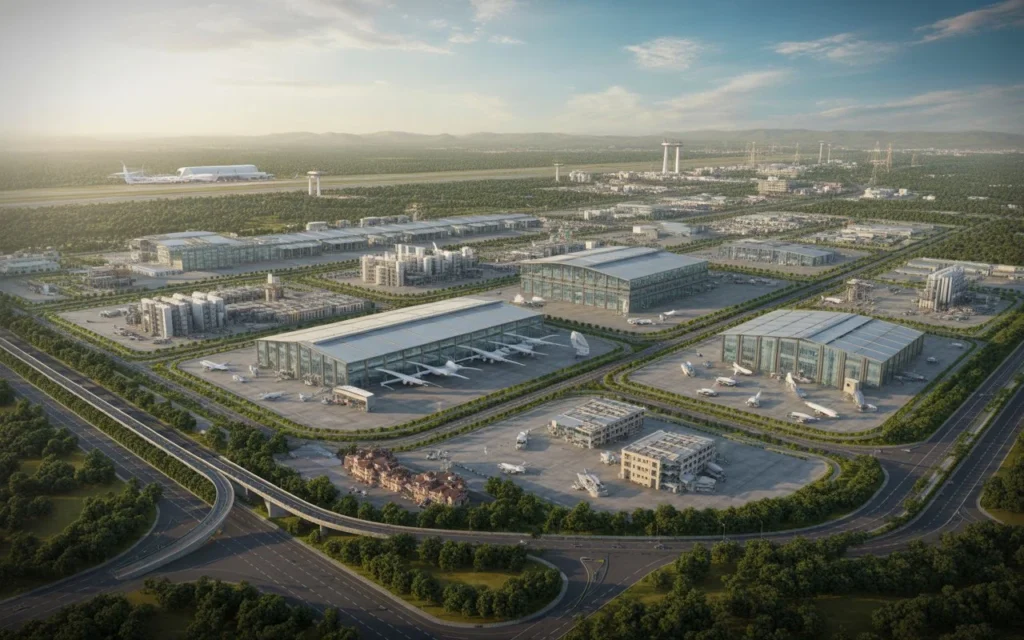
While IT parks dominate the conversation about North Bangalore’s employment landscape, a broader industrial and economic infrastructure is simultaneously building in the corridor — including Special Economic Zones, aerospace and defence facilities, logistics hubs and advanced manufacturing centres that collectively diversify the employment base beyond pure technology dependence. Understanding the SEZ impact on North Bangalore real estate reveals additional demand drivers that strengthen the investment case for residential properties on Hennur Main Road and the broader northern corridor.
Industrial Corridor Property Growth — Beyond IT
The industrial corridor property growth in North Bangalore is driven by the strategic positioning of the corridor between two major economic anchors — the central Bangalore urban economy to the south and Kempegowda International Airport to the north. This positioning makes the northern corridor attractive for industries that require both urban workforce access and airport logistics connectivity.
The KIADB Aerospace SEZ in the Devanahalli zone — approximately 20 to 25 kilometres from Hennur Main Road — houses aerospace, defence and precision manufacturing companies that employ highly skilled engineers, scientists and technical professionals. While this facility is beyond the immediate commute zone for daily Hennur Road residents, its presence strengthens the broader North Bangalore economic ecosystem that supports residential demand and infrastructure investment across the entire corridor.
Closer to Hennur Road, the commercial and industrial activity along the Outer Ring Road — accessible from the corridor’s southern terminus — provides employment in logistics, distribution, corporate services and light manufacturing that adds demand diversity beyond the technology sector. Each sector employs professionals at income levels that support premium apartment demand within practical commuting distance.
SEZ Effect on Housing Demand
The SEZ effect housing in North Bangalore operates through both direct and indirect channels. The direct channel is employment generation — professionals working at SEZ facilities need housing within commuting distance and generate rental and purchase demand in surrounding residential markets.
The indirect channel operates through economic multiplier effects. When a major employer establishes operations — particularly in high-value sectors like aerospace and defence — they attract supporting businesses, service providers, suppliers and ancillary operations that generate their own employment and housing demand. A single anchor employer can catalyse an ecosystem of secondary employment that multiplies the direct housing demand by a factor of two to three times.
For Hennur Main Road specifically, the SEZ and industrial corridor effects are primarily indirect — strengthening the broader North Bangalore economy, supporting infrastructure investment and enhancing the corridor’s long-term growth trajectory rather than generating direct foot-traffic-level demand from specific employers. The primary employment anchors for Hennur Road residents remain Manyata Tech Park and the ORR corridor offices.
However, the diversification that SEZs and industrial facilities bring to the North Bangalore economy provides demand resilience that benefits all residential markets in the zone. If the IT sector experiences a cyclical slowdown, the aerospace, defence and manufacturing sectors — driven by government contracts and industrial policy rather than global technology spending — continue generating employment and housing demand.
Employment Hub Effect on Real Estate Values
The broader employment hub real estate relationship supports property values through the sustained demand mechanism that concentrated employment creates. When multiple employment hubs — IT parks, corporate campuses, SEZs, industrial facilities — concentrate within the same geographic corridor, the aggregate demand for residential properties in surrounding localities intensifies beyond what any single employer could generate alone.
North Bangalore’s employment concentration is among the highest in the city — combining Manyata Tech Park, M S Ramaiah Tech Park, Ebisu Tech Park, Kirloskar Business Park, Bhartiya Centre of Information Technology, the KIADB Aerospace SEZ and the airport zone commercial ecosystem into a cluster that collectively employs hundreds of thousands of professionals across multiple sectors.
This employment concentration creates a residential demand base that is both large and diversified. For property values on Hennur Main Road, the implication is that demand support comes from a broad economic foundation rather than dependence on any single company, sector or facility. This breadth provides value stability during sector-specific downturns and supports consistent appreciation across economic cycles.
Infrastructure Investment Driven by Economic Activity
The concentration of economic activity in North Bangalore drives government infrastructure investment — road widening, flyover construction, metro planning, utility upgrades — that benefits residential properties throughout the corridor. Governments prioritise infrastructure spending in corridors where economic activity and population growth generate both the demand for improved infrastructure and the tax revenue to fund it.
For Hennur Main Road, this economic-activity-driven infrastructure investment is visible in the road widening currently under construction, the metro extension in planning and the progressive improvement of junction infrastructure along the corridor. Each of these investments is justified by the economic activity and residential population growth that the employment concentration is generating.
Buyers at Purva Codename Hennur benefit from this infrastructure investment cycle because each completed project enhances the corridor’s connectivity, livability and attractiveness — supporting property value appreciation that accrues to existing owners.
For the broader IT ecosystem impact on Bangalore housing and the government policies supporting real estate, explore our dedicated analyses.
To discuss how economic corridor development supports your investment, connect with our advisory team.
FAQs
What is the SEZ impact on North Bangalore real estate?
SEZ developments generate employment, attract businesses and increase residential housing demand across North Bangalore corridors.
How do SEZs influence housing demand?
SEZs create direct demand from employees and indirect demand through supporting industries, services and infrastructure expansion.
Why is North Bangalore seeing industrial corridor growth?
Airport connectivity, major infrastructure projects and land availability make North Bangalore attractive for industrial and commercial growth.
How do employment hubs affect property values?
Large employment clusters increase residential demand, support rental growth and strengthen long-term property appreciation.
Does industrial development improve infrastructure in North Bangalore?
Yes, economic activity drives road widening, metro planning, flyover construction and utility upgrades across the corridor.