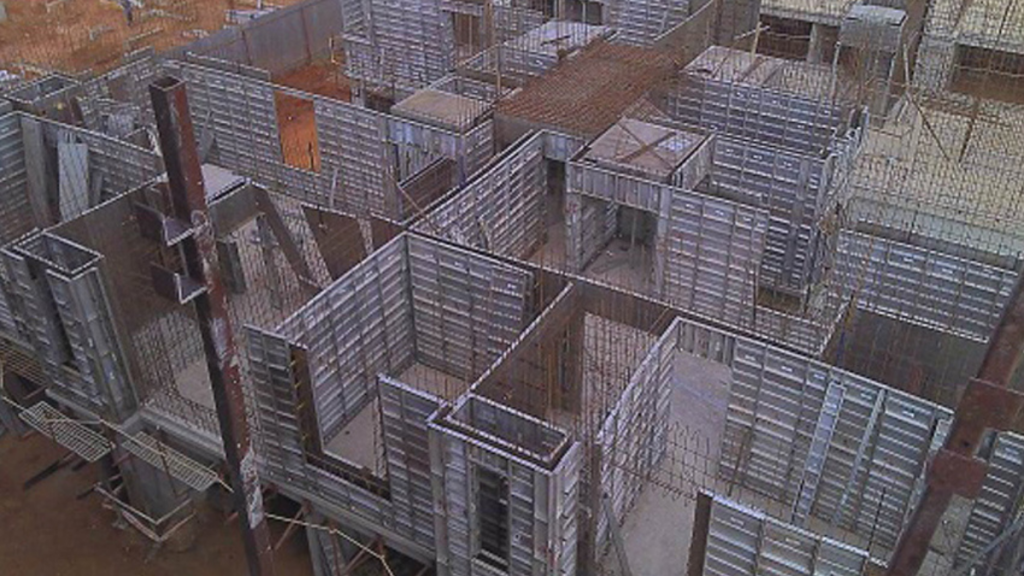
Construction technology is the invisible foundation upon which every specification, every finish and every living experience is built. The most beautiful Italian marble flooring loses its appeal if the wall behind it cracks within three years. The most elegant bathroom fittings become frustrating if the plumbing infrastructure beneath them fails. At Purva Codename Hennur, the construction approach combines Mivan aluminium formwork technology with RCC framed structural design to deliver a building that is engineered for precision, durability and long-term performance. This article provides a comprehensive Purva Codename Hennur construction status update and explains why the construction technology choice matters as much as the specifications it supports.
Understanding Mivan Construction at Purva Codename Hennur
Mivan construction quality is defined by the aluminium formwork system that replaces conventional brick-and-plaster wall construction with precision-moulded concrete casting. In this system, aluminium panels are assembled on site to create moulds for walls, columns and slabs. Concrete is then poured into these moulds in a single integrated operation. When the formwork is removed, the walls emerge with smooth, dimensionally precise surfaces that require minimal additional finishing.
The fundamental advantage of Mivan over conventional construction is consistency. In conventional building, wall quality depends on the skill of individual masons — their bricklaying precision, their plastering technique and their attention to straightness and levelness. This human variability produces walls that can differ in thickness, straightness and surface quality not just between floors but between adjacent rooms on the same floor.
Mivan eliminates most of this variability. Every wall cast within the same set of precision moulds achieves identical dimensions, identical surface quality and identical structural properties. For a 24-floor tower like Purva Codename Hennur, this means that the apartment on the third floor and the apartment on the twenty-third floor receive walls of identical quality — a consistency that conventional methods simply cannot guarantee at scale.
The 10-foot clear ceiling heights specified at Purva Codename Hennur are more achievable with Mivan technology than with conventional construction, because the formwork system accommodates non-standard dimensions without the additional complexity and quality risk that unconventional heights introduce in manual construction.
RCC Framed Structure Benefits
The RCC framed structure benefits at Purva Codename Hennur complement the Mivan wall construction with a reinforced concrete frame that provides the primary structural skeleton of the building. The RCC frame — comprising concrete columns, beams and slabs reinforced with steel — carries the building’s gravity loads and lateral forces, while the Mivan-cast walls provide both structural participation and the interior room divisions.
This dual-system approach — RCC frame plus Mivan walls — delivers a structure that is stronger than either system alone. The RCC frame provides ductility and flexibility under seismic loads, while the Mivan walls provide additional shear resistance and structural stiffness. Together, they create a building that responds to earthquakes with a controlled flexibility that prevents catastrophic failure while maintaining structural integrity.
For a building rising 24 floors above three basement levels — a total structural height that is substantial — the engineering demands on the structural system are significant. Wind loads at upper floors, seismic forces across the full building height and the differential settlement potential across the footprint all require a structural system that is engineered with conservative safety margins. The RCC plus Mivan approach at Purva Codename Hennur addresses these demands through a methodology that Puravankara has validated across their national project portfolio.
Construction Timeline for Hennur Road
The construction timeline Hennur for Purva Codename Hennur is estimated at approximately four years from launch to possession. This timeline reflects the construction sequence for a single-tower development with two wings, three basement levels and 24 residential floors.
Mivan construction significantly accelerates the superstructure phase compared to conventional methods. A typical floor cycle with Mivan technology takes approximately seven to ten days, compared to twenty to thirty days with conventional construction. For 24 residential floors, this translates to a superstructure completion timeline of approximately six to eight months — substantially faster than the twelve to eighteen months that conventional construction would require.
The overall timeline includes foundation and basement construction across three levels, superstructure construction using Mivan formwork, internal finishing including premium flooring, VRV air conditioning installation, smart home wiring and fixture fitting, external facade work, common area completion including the 20,000 sq ft clubhouse, landscaping and infrastructure, and testing, commissioning and pre-handover quality audits.
The Mivan acceleration benefit is most pronounced during the superstructure phase but also contributes to faster internal finishing because the precision walls produced by Mivan require less preparatory treatment before specifications are installed — unlike conventional plastered walls that often need multiple rounds of correction before they are ready to receive premium finishes.
For a detailed understanding of how this timeline translates into a possession date and handover process, explore our dedicated guide. For the RERA approval status that governs the formal construction commencement, read our regulatory update.
What Construction Quality Means for Daily Living
The practical impact of the Mivan and RCC construction approach at Purva Codename Hennur extends beyond structural engineering into daily living quality. The precision-cast walls provide superior acoustic insulation between apartments — particularly important in a design where no shared walls already minimises inter-unit sound transmission. The dimensional consistency of Mivan walls ensures that flooring, fixtures and fittings align precisely with their designed positions, eliminating the misalignment issues that plague conventionally constructed apartments.
The structural integrity of the RCC-Mivan system also provides long-term maintenance benefits. Mivan walls are significantly less prone to cracking than plastered brick walls, which means fewer repair interventions over the building’s lifespan. Water ingress — a common defect in conventional construction where plaster-brick interfaces create potential leak paths — is substantially reduced in monolithic Mivan walls where joints are minimised.
For a project that specifies 10-foot ceilings, VRV air conditioning, smart home automation and premium finishes, the construction technology must be capable of supporting these specifications reliably over decades. Mivan and RCC construction provides exactly this capability — a structural foundation that is worthy of the ultra-premium specifications built upon it.
Puravankara’s Construction Track Record
Puravankara Limited has been delivering residential projects across India since 1975 — a nearly fifty-year track record that encompasses multiple construction technology evolutions. Their adoption of Mivan construction for Purva Codename Hennur reflects the developer’s commitment to deploying the most appropriate technology for each project’s specific requirements.
The organisational experience to manage Mivan construction — including the procurement of formwork systems, the training of specialised labour teams and the quality control protocols specific to aluminium formwork — is built upon decades of construction management experience. For buyers, this means that the Mivan deployment at Purva Codename Hennur is supported by institutional capability rather than being an experimental first attempt.
For a deeper understanding of the Puravankara construction quality standards and the payment plan that aligns with the construction timeline, explore our dedicated guides.
For the latest construction progress updates and site photographs, connect with our advisory team. Visit the specifications page for construction and material details.